But when this priest had offered for all time one sacrifice for sins, he sat down at the right hand of God, and since that time he waits for his enemies to be made his footstool.
Hebrews 10:12 NIV
Readers of this blog will be aware that between the middle ages and the move to St Andrew the Great in 1994 our congregation met in Cambridge’s historic Round Church. You may be less aware that the Round was at the centre of a great dispute in the middle of the nineteenth century – a dispute we can learn from.
It began in August 1841 when the church’s little tower collapsed. It was clear that the building needed significant renovation, and an offer of help with design and fund-raising came from the Cambridge Camden Society.
This local body was advocating the renewal of medieval church architecture, and had sympathies resonant to another movement at the time, the so-called Tractarian or Oxford Movement. This sought to take churches in a more Catholic direction. So it was that, in the course of the renovations a stone altar was installed, fixed to the building’s east wall.
The vicar at the time, Richard Faulkner, lived in Essex! However, he found out about the altar and objected. He could not get it removed, so took his churchwardens (who’d supported this development) to an ecclesiastical court.
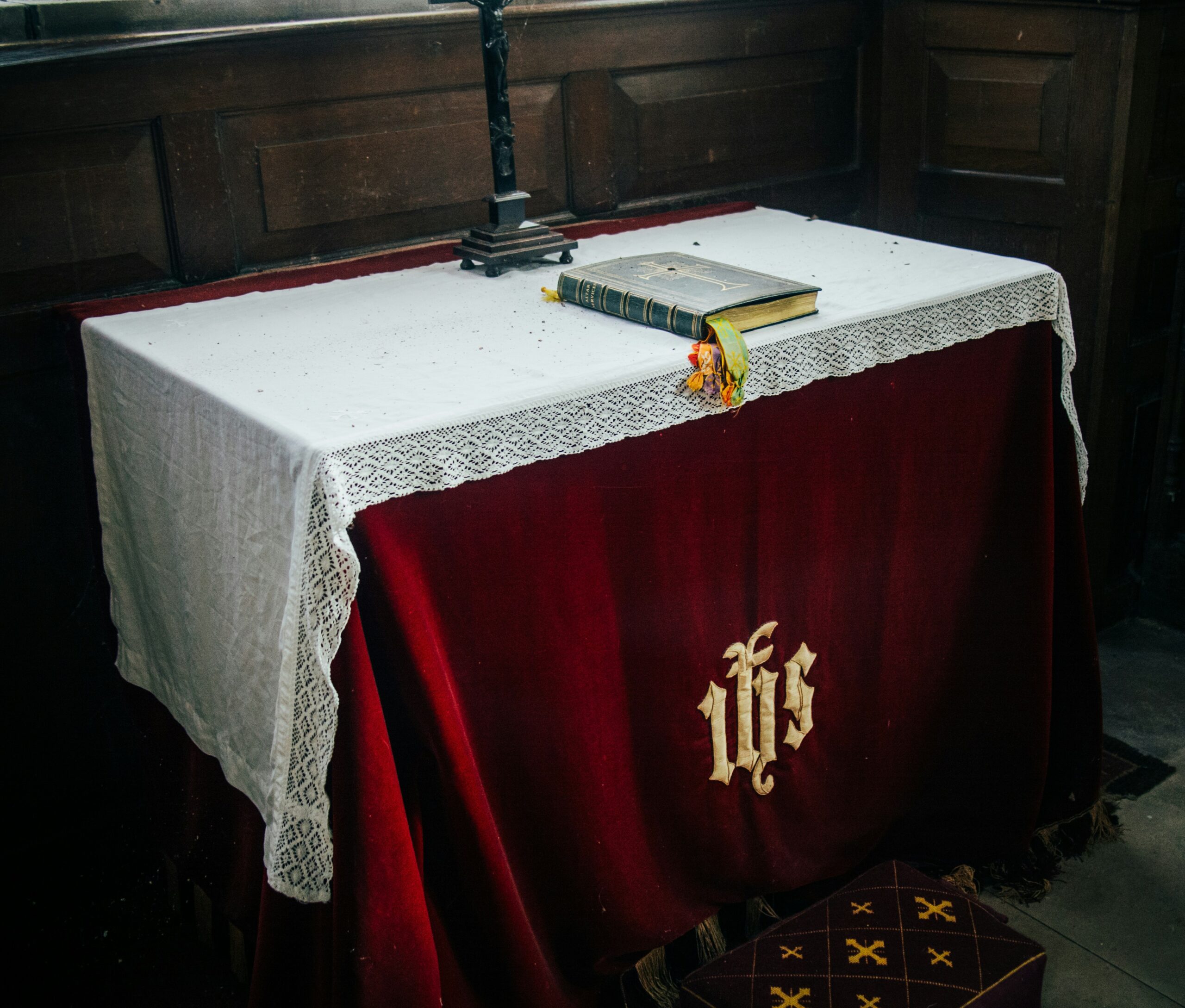
At issue was this point: an altar is a place where sacrifices are offered, but that in the Church of England since the Reformation, we’ve had communion tables. A table isn’t a place of sacrifice, but the setting for a meal, in this case the meal which Jesus gave us, the Lord’s Supper, at which we remember and benefit from Christ’s once-for-all sacrifice of Himself on the cross. Priests in the Old Testament needed an altar, for they offered repeated sacrifices; but now Jesus has offered Himself, once for all, and an altar implicitly denies that wonderful reality.
The case attracted national publicity. It proceeded to the highest church court in England, the Court of Arches, and the judge, Sir Herbert Jenner-Fust, ruled in favour of Faulkner and against the wardens. His judgment looked right back to the Reformation, when Archbishop Thomas Cranmer had taken the Church’s medieval prayer book and struck out all references to altars, replacing them with ‘table’. Sir Herbert also cited King Edward VI’s command at the time ‘to pluck down altars everywhere, and place instead thereof honest table, which might more readily move the simple from their superstitious opinions of the popish mass unto right understanding of the Lord’s Supper.’
The altar was removed from the Round Church and broken up. Still to this day, the official liturgies of the Church of England use the words ‘holy table’ instead of altar.
This is not just some obscure historical spat, of the kind we might preen ourselves on avoiding. It does matter. We are custodians and heralds of the most wonderful news: that when He died on the cross, our Lord Jesus Christ did everything necessary to deal with the guilt of all who trust in Him, and to open up the way to God. ONCE AND FOR ALL!
We continue our series on Hebrews – where this wonderful news is so emphatically taught – this Sunday.