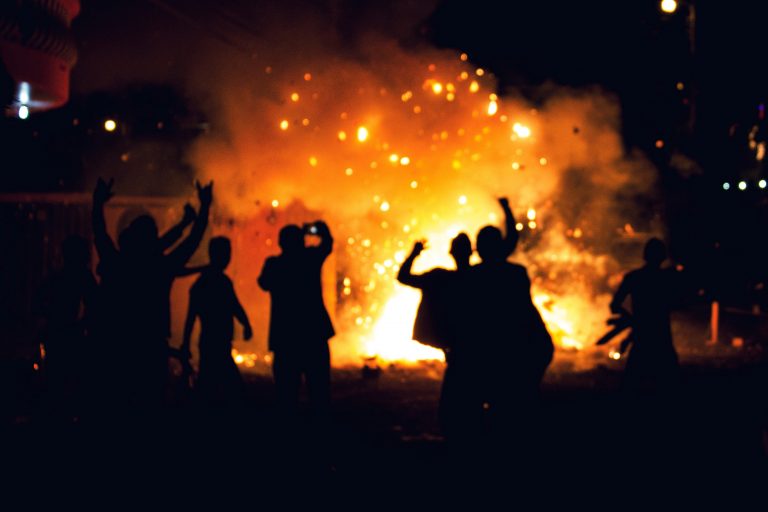
So Moses thought, “I will go over and see this strange sight - why the bush does not burn up.”
Exodus 3:3 NIV
Many of us at church small groups are reading the book of Exodus this term, and early on we encounter one of its strangest episodes.
Moses was grazing his father-in-law’s sheep in the wilderness country of Horeb. One day he saw a bush on fire. That was a strange sight – though not impossible after a thunderstorm. But what was really odd was that the bush wasn’t itself being burned. No leaves being blackened, no ash – but still the bush was on fire! How so?
Moses’ question turns out to be a picture of a huge question the Bible raises.
It’s clear that the fire in the bush stands for the presence of God Himself; it is He Who speaks from within the bush. This is holy ground, and Moses is not to come too close. And yet God introduces Himself as the God of your father, the God of Abraham, the God of Isaac and the God of Jacob. Here is God in all His burning holiness – in relationship with ordinary, sinful people!
How can this be? The question the burning bush raises isn’t just a matter of physics, but the bigger, more vital question of how the holy God can have fellowship with sinful people without their being consumed.
The same question runs on through Exodus. God (symbolised by fire) accompanies His people across the desert of Sinai. They are not to get too close! And yet He is among them – most graphically pictured by the Tabernacle, His dwelling-place in the middle of the camp. How is this possible?
The question is made even more acute in the episode of the Golden Calf, which reveals the people’s true character. Even God Himself raises the question of whether He can dwell with these people, who deserve to be destroyed. How can this be possible?
The question may not bother us – but if we know something of the holiness of God, and our own sinfulness, it should. As the writer to the Hebrews tells us, Our God is a consuming fire. How can we have fellowship with Him?
The answer comes at the cross of Christ. There, our Lord Jesus was consumed for us, taking our place, so that those who trust in Him may dwell with God, in our midst, up close and personal, calling Him Father – and yet not be destroyed. Exodus is pointing us to Calvary.
I like the name of our church. But if ever we wanted an alternative, “The Burning Bush” wouldn’t be a bad substitute. We gather in the presence of the living God; we have the wonder of access to Him, even though we are sinners. Ponder – and wonder!